Dear friends,
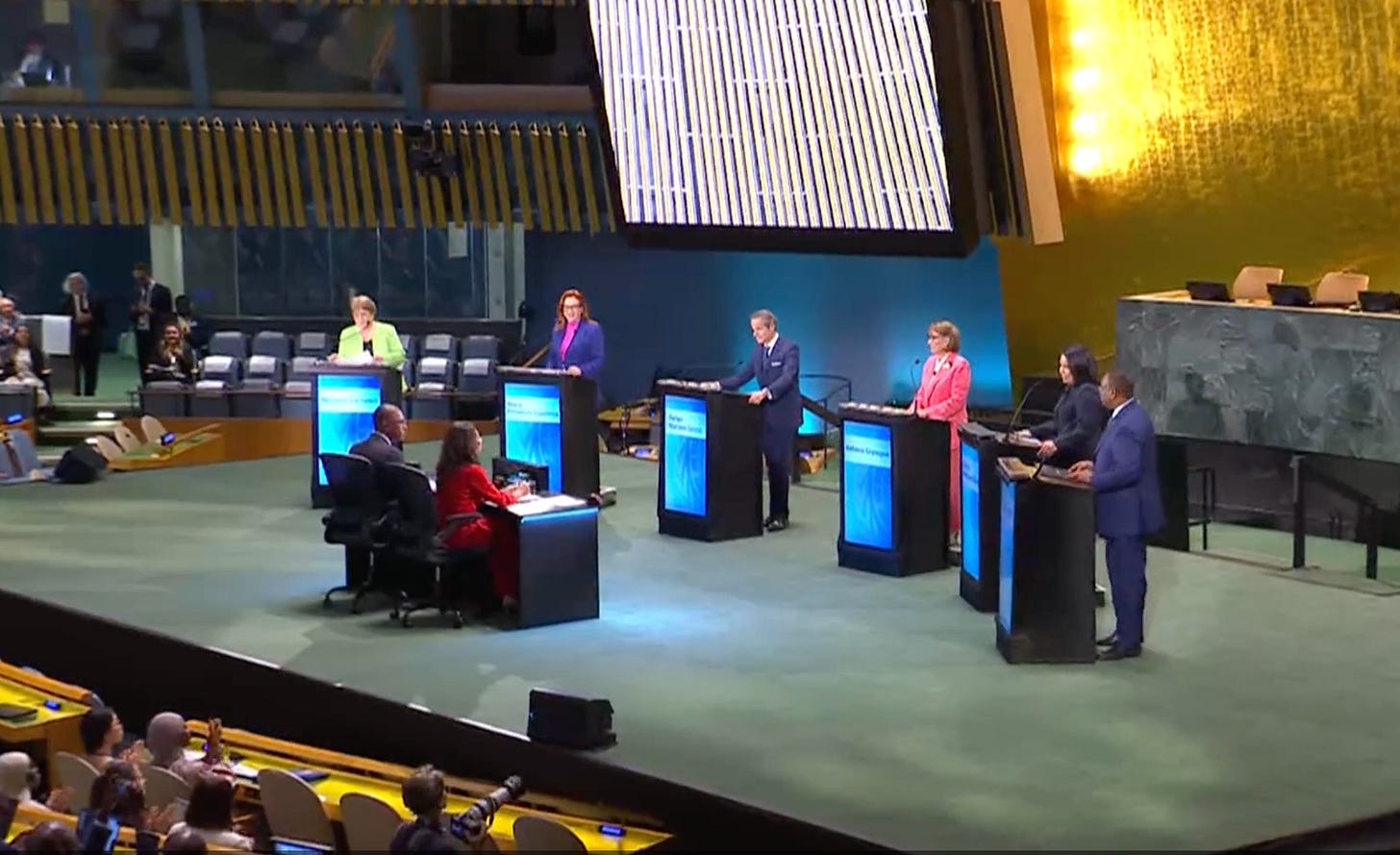
I’m breaking my no-computer holiday rule because something happened at the UN last Thursday. Any guesses? The UN hosted a “townhall” with all the candidates who’ve been endorsed by a state to become the next Secretary-General. Read this newsletter to learn about the attempts by the UN to put up a smokescreen instead of enabling real democracy; who stood up for what’s right; what the next steps are in the selection-process of the UN Chief; and who is the latest candidate in the race.
First, let’s get back to basics.
You may remember that the UN - which is supposed to ensure our basic rights -chooses its chief in a process that would make the maddest dictator ashamed. In short: every five years, a few world powers choose the Chief of the United Nations behind closed doors and without any public involvement, resulting in a man being selected to preserve the status quo.
That’s obviously an oversimplification, but it’s the gist of it.
The current UN secretary-general’s term ends on December 31st, 2026. The UN has thus launched its usual untransparent and undemocratic process, dressing it up with a few open Q&As and other cosmetic changes, including last week’s townhall. Then the five permanent Security Council members — the US, UK, France, Russia, and China — will make the actual decision later this year. What is the point of town halls without a real vote?
I’m not just criticising the UN. I campaigned for the last two years for the position,and will continue to do so in a bid to force reform and push forward a radical political agenda!
Who opened the townhall
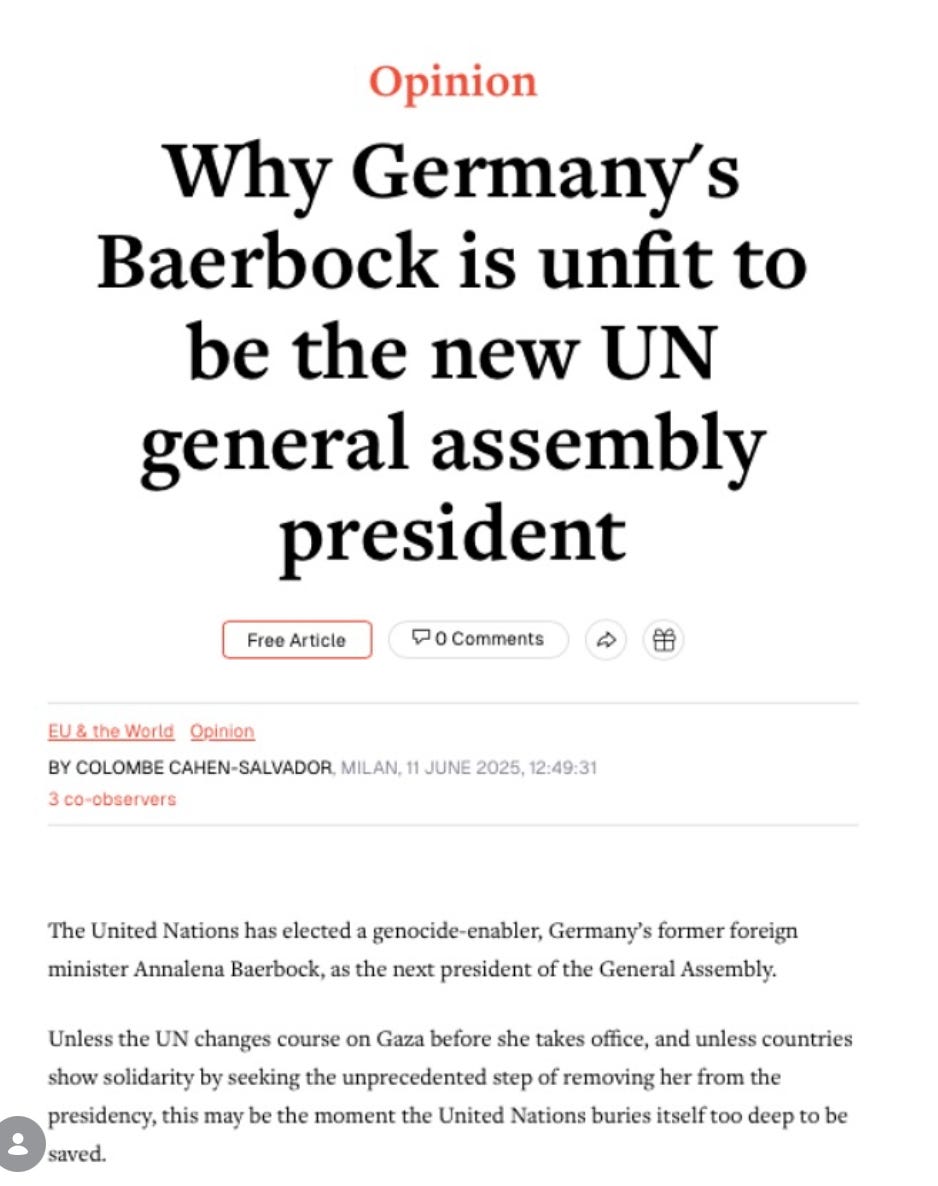
The UN General Assembly President opened the townhall. That’s Baerbock, a genocide enabler. As Germany’s foreign minister from 2021 to 2025, she rejected ceasefires while her country kept sending Israel hundreds of millions of dollars in weapons, making it Israel’s second biggest arms supplier. I wrote about it when she took the role.
Six candidates took part. 80 years of men. Zero excuse.
Six candidates took part in the townhall: María Fernanda Espinosa Garcés, Rebeca Grynspan, Michelle Bachelet, Rafael Grossi, Carolyn Rodrigues Birkett, and Macky Sall.
80 years of men at the helm of this organisation is 80 years too long. Sall and Grossi should withdraw. There are four women in this race at least as qualified as they are.This isn’t only about gender, but this time, gender should be a prerequisite to being selected.
“I, I, I”
All candidates started with opening remarks about themselves. I, I, I. All more or less said multilateralism is in crisis but can deliver if reformed. No one said how specifically. Some mentioned global challenges without saying how to tackle them. Some mentioned the UN is absent from resolving the most serious conflicts we see. NO ONE NAMED THE CONFLICTS, NOR THE PERPETRATORS.
You can watch the townhall for yourself.
Onto questions
-
Does it not infuriate you that journalists frame Gaza as a “crisis”? Israel is committing genocide there. Name the perpetrator. Bloomberg reduced Gaza to a story about the limits of UN influence, an organisation that can document suffering but not compel anyone to change course. Can you not name Israel, the crimes, or the genocide?
-
Bachelet talked about moral authority. How can you claim that without naming the perpetrators concerned?
-
Sall bragged about meeting Putin after the start of Russia’s illegal invasion of Ukraine, and called that invasion a “tension.” This townhall alone discredits him.
Not one candidate could be precise, name a perpetrator, or take a position. They diminished their own potential role as chief, saying “it’s not my role as SG” every two seconds, instead of leading with the power of their position. They refused to put any skin in the game.
When asked what they hope to achieve during their mandate if elected, every single one of them talked about the organisation. Few even mentioned the crises, the crimes, the challenges the UN is supposed to solve with and for us, the people.
The most boring political debate I’ve ever heard
Maybe because this wasn’t a political debate, or one for a real election. Let’s make a parallel. Imagine this: 193 people enter a great hall. One by one, they stand up and cast their votes. But here’s the twist: out of all 193 votes, only five people have the power to decide the outcome. It does not sound like democracy, does it? More like a plot twist from a political thriller.
But this is not fiction. It is the reality within the United Nations. While 193 countries are told they have a say, it’s the five permanent members of the Security Council who choose the next Secretary-General. Democracy à la UN.
The two who actually stepped up
Grynspan has passion for the topics she talks about, and stood up for the UN when asked what she would cut, pointing that this was fundamentally the wrong way of thinking about live-saving programmes.
Carolyn Rodrigues Birkett showed humility, empathy, and care for the people she spoke about. She called out the nations that hoarded vaccines during the pandemic and named it survival of the fittest. She said the Secretary-General must use her voice to prevent that, and that the General Assembly must come together for wisdom, reiterating the role of the world against the role of five countries.
A seventh candidate, and he built the very process I’m fighting
Following the townhall, Uganda nominated a seventh candidate: Olara Otunnu, 75. He is not new to this machinery. As President of the Security Council in December 1981, he designed the straw poll procedure the Council still uses today. He built this mad process.
On Gaza, his vision statement he proposes combining the Oslo Accords with the Abraham Accords framework toward “permanent peace”, without ever addressing the root causes, nor denouncing Israel’s crimes: occupation, apartheid, genocide. On Ukraine, he does not name Russia as the aggressor. On climate, he wants action only “where economically viable” and without “sacrificing economic prosperity.”
I could keep on going, but honestly it’s not worth it: the next UN Chief must be a woman, and a radical one!
What none of them will say
You won’t hear the word genocide. You won’t hear Israel named as the perpetrator in Gaza, nor Russia condemned for its illegal war on Ukraine. You won’t hear a commitment to phase out fossil fuels. You won’t hear support for a billionaires tax. You won’t hear a legal path around the Security Council veto for when it’s blocking action on an actual genocide, war crimes, or crimes against humanity. You won’t hear a pause on superintelligence development until the world agrees on the rules, or a real pandemic treaty that ends vaccine apartheid instead of managing the next one.
What you will hear is multilateralism is in crisis, this is an inflection point, reform is needed. Weak as hell.
What’s next in the selection-process?
This Thursday, the Security Council is expected to hold its first straw poll. It is not a decision. It is a test.
Here’s how it works. Behind closed doors, each of the 15 Council members marks every candidate encourage, discourage, or no opinion. No one outside that room sees the results.
If no single candidate clears the bar, they do it again. This repeats, round after round, narrowing the field each time, until one candidate has at least nine votes and faces no veto from any of the five permanent members: the US, UK, France, Russia, China.
Only then, with that one name and no other, does the Council send its recommendation to the General Assembly. That’s expected sometime between August and October.
Where does this leave us, the people?
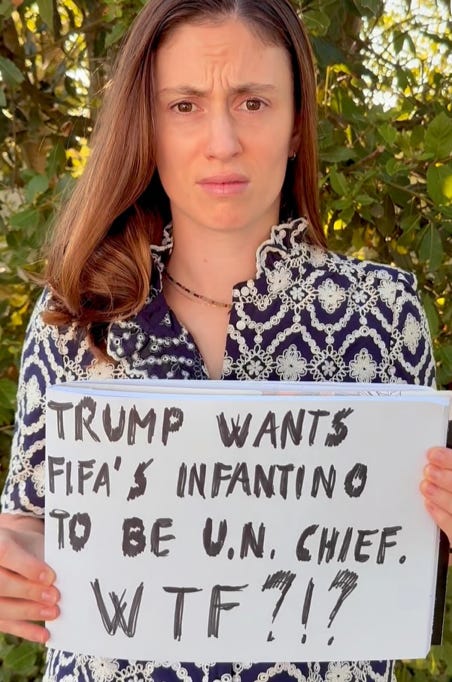
I won’t lie and pretend that this process is promising for the world, and gives a living chance to the United Nations. This selection-process is even grimmer than I could have expected, with mad-men heading too many countries with a veto power, an unwillingness to ever prioritise the common good, and candidates to scared to speak up. Just imagine that Trump is contemplating nominating FIFA’s Infantino for the role. As a friend said, “we live in a circus.”
But all is not lost. Some candidates, such as Grynspan and Rodrigues-Birkett, show genuine passion on their topics of predilection. If selected, they could help in changing the organisation if they decide to use their office for more than behind-a-desk weak diplomacy. If they decide to stand up to superpowers and push the UN to be relevant, to stand with us, the peoples!
That’s why, two years after launching a campaign to challenge this broken & undemocratic system, I'll keep on campaigning. I wasn’t endorsed by a state, but I'll push candidates to adopt our programme and to enact reform so that climate change, poverty inequalities, wars, unregulated big tech, pandemics and more can finally be reigned in!
Let me know what you think, and how you are working to change the world!
Onward,
Colombe
—
Colombe Cahen-Salvador (she/her)
Co-Founder & Candidate for United Nations Secretary-General
Atlas
Youtube | Substack | Facebook | X | LinkedIn | Instagram | TikTok | Threads | Bluesky
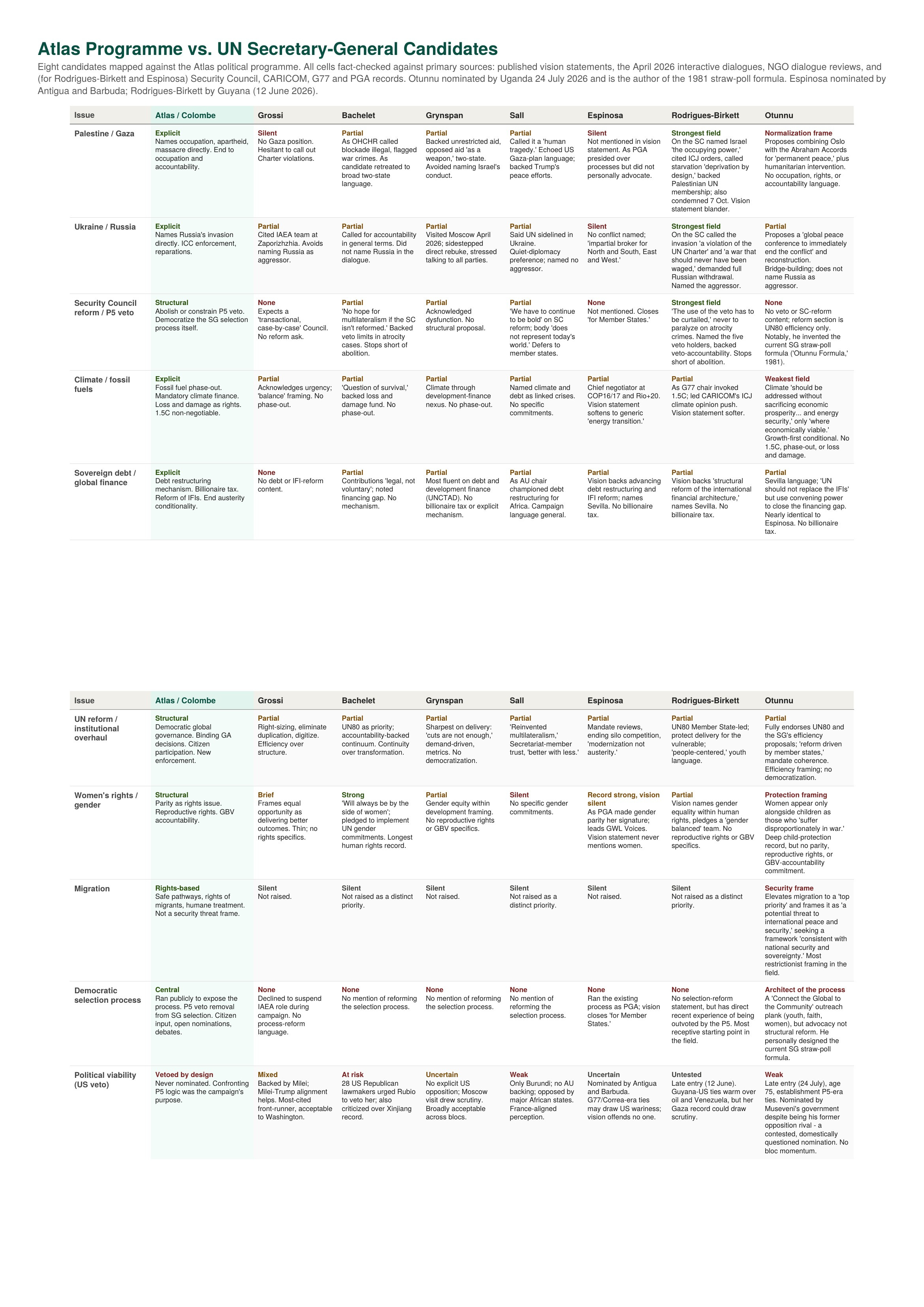
PS: Here’s Claude’s analysis of candidates’ statements and vision statements, versus our programme at Atlas.